Why Facebook Keeps Banning Your Ad Account (and How to Stop It)
Facebook does not ban accounts at random. Here is how Meta scores trust, the real reasons ad accounts get disabled, and the infrastructure setup that keeps your campaigns alive while everyone else keeps losing accounts.


The Ban That Feels Like It Came Out of Nowhere
You log in to launch a campaign, and the account is gone. No warning, no clear reason, just a red banner telling you the ad account has been disabled. If you run Facebook ads at any real volume, you already know this feeling, and you know how expensive it is. Every disabled account means paused campaigns, lost learning phases, wasted creative, and hours burned in an appeal queue.
Here is the part most advertisers miss: Facebook almost never bans an account "out of nowhere." Meta runs one of the most aggressive automated trust and risk systems on the internet, and every action you take either builds trust or spends it. Once you understand how that system thinks, bans stop looking like bad luck and start looking like a math problem you can actually solve.
At GOADS we have watched thousands of accounts live and die, and the pattern is remarkably consistent. The advertisers who keep getting banned are almost always making the same handful of mistakes, and the ones who scale calmly for months are quietly doing the opposite.
How Facebook Actually Decides to Ban You
Think of every Facebook asset, the profile, the Business Manager, the ad account, the page, as carrying an invisible trust score. That score is shaped by hundreds of signals, and Meta constantly asks one question: does this look like a real business run by a real person, or does it look like a throwaway set up to break the rules?
The signals that move your score fall into three broad buckets:
- Identity and history. How old is the profile, does it have a genuine history of normal activity, has it been verified, and does the Business Manager look established rather than freshly created.
- Environment. The IP address and proxy, the browser fingerprint, the device, and whether your login pattern looks human and consistent or scattered across dozens of accounts on one machine.
- Behavior. How fast you spend, how sharply you scale, your payment method, your landing pages, and whether your ads and destinations follow Meta policy.
A ban happens when the combined risk crosses a threshold. Sometimes it is one severe violation. More often it is an accumulation, a cold account plus a shared IP plus an aggressive first-day budget, that quietly pushes you over the line. This is why two advertisers running the exact same creative can get completely different outcomes: their trust foundations were never equal to begin with.
The Most Common Reasons Accounts Get Disabled
Across the accounts we support, the same causes come up again and again. If you keep getting banned, you are almost certainly hitting one or more of these:
- Brand-new, cold assets. A profile or Business Manager created yesterday has no trust to spend, so it breaks at the first sign of pressure.
- Dirty or shared IPs. Free VPNs, data-center proxies, and IPs already flagged from other banned accounts tell Meta exactly what you are doing.
- Poor account isolation. Running many accounts in one normal browser leaks a shared fingerprint that links them all, so one ban becomes ten.
- Spend spikes. Going from a few dollars to hundreds overnight is one of the loudest fraud patterns there is.
- Policy issues in ads or funnels. Cloaking, prohibited products, misleading claims, or a low-trust landing page will sink even a strong account.
- Payment red flags. Mismatched billing country, a card that keeps failing, or a payment profile tied to prior bans.
Notice that only some of these are about your ads. A large share of bans are decided before your first impression ever serves, at the infrastructure layer, and that is exactly the layer most advertisers ignore.
Why Fresh Accounts Die the Fastest
There is a reason experienced media buyers pay a premium for aged, reinstated profiles instead of spinning up free ones. Trust on Facebook is earned over time, and a brand-new account simply has none. It has no history, no established connections, and no track record of behaving like a normal user. To Meta's risk system, that emptiness reads as risk.
A profile that has existed for years and carries a real history behaves completely differently. It has already proven it is not a throwaway. When you attach a verified Business Manager and warm it up sensibly, you are stacking trust instead of starting from zero. That is the difference between an account Meta treats as legitimate and one it treats as a suspect.
You are not really buying an account. You are buying the years of trust and the survived reviews baked into it.
This is also why "reinstated" matters so much. A profile that was flagged and then successfully appealed has effectively been stress-tested by Meta itself. Our super aged profiles have survived two full review cycles, which is about as resilient as an asset gets. If you want the full breakdown, see our guide on building a foundation before you scale.
The Infrastructure Layer Most Advertisers Skip
Great creative on a weak foundation still gets banned. If you want campaigns that survive, you have to treat your infrastructure as seriously as your ads. Three pieces do most of the work:
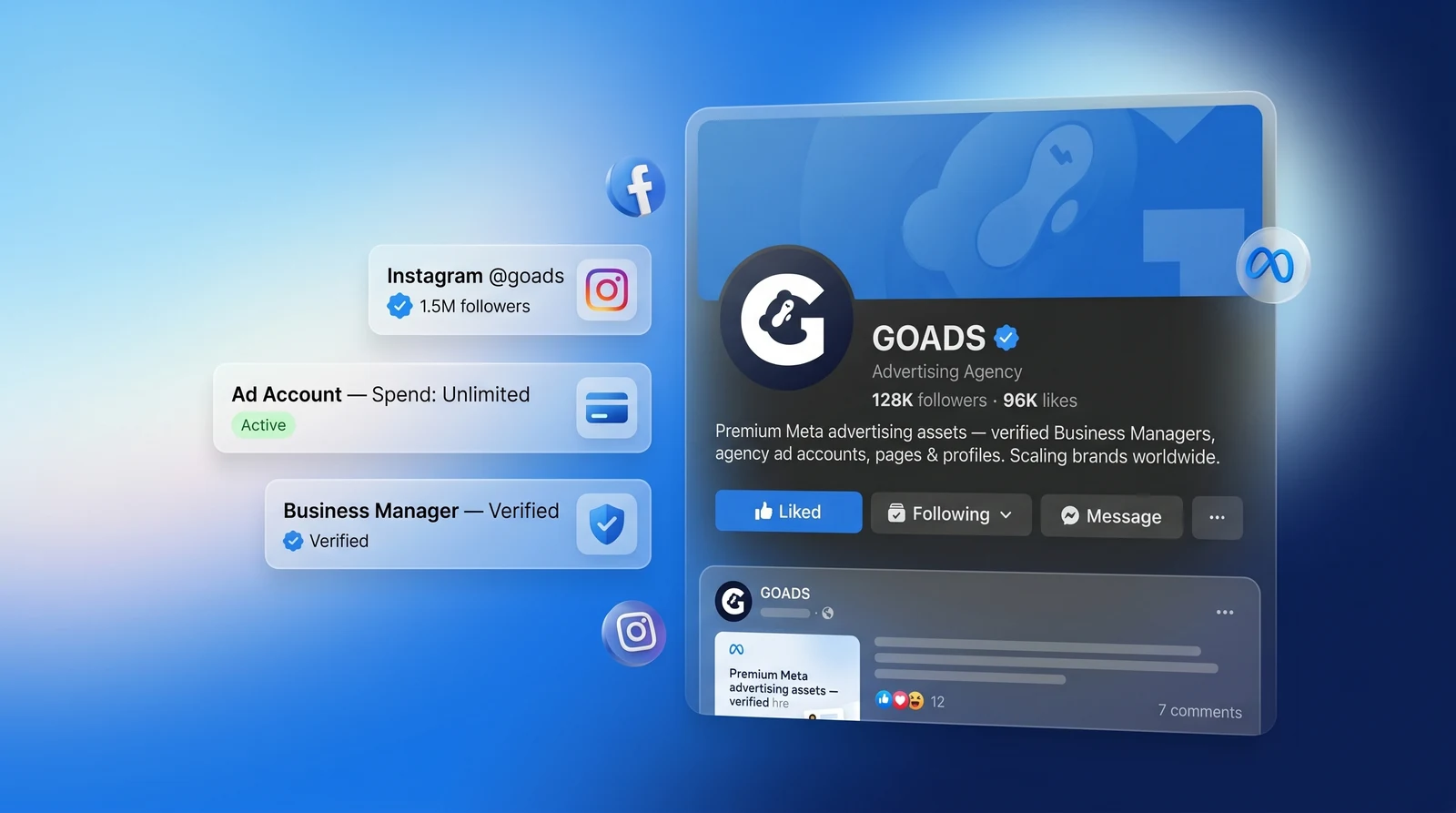
- Aged, reinstated profiles. The trusted identity your ads run under. GOADS specializes in cleanly nurtured Premium and Super Aged profiles built and warmed on real residential IPs, with 1 to 15 years of history depending on the tier.
- Verified Business Managers. A BM with real spending history and verification is far harder to disable than a fresh one. Our BM5 Verified and Unlimited DSL options carry spending history, support pixel sharing, and hold up under long-term use.
- Clean residential and mobile proxies. A stable, non-flagged IP that matches your profile's region keeps your environment consistent and quiet.
Pair those with an anti-detect browser so every account gets its own isolated fingerprint, and you remove the two most common reasons accounts get linked and mass-banned. This is exactly why our GOADS and Dolphin Anty partnership exists: trusted assets behind sophisticated, isolated browser profiles.
A Ban-Resistant Setup Checklist
Before your next launch, run through this. Every "yes" is trust in the bank:
- Am I running on an aged, reinstated profile rather than a fresh one?
- Is my Business Manager verified, with real spending history?
- Does each account have its own clean residential or mobile proxy?
- Is every account isolated in its own browser profile with a unique fingerprint?
- Am I warming up new accounts gradually instead of spiking spend on day one?
- Are my ads and landing pages genuinely policy-compliant, with no cloaking?
- Is my payment method consistent, funded, and matched to the account region?
If you cannot answer yes to most of these, that is your ban risk, and the good news is that all of it is fixable before you spend another dollar.
What to Do the Moment You Get Banned
Even with a strong setup, bans happen. What separates the pros is how fast and calmly they recover. When an account goes down:
- Do not panic-create. Spinning up a new cold account on the same machine and IP is the fastest way to lose that one too. Isolate first.
- Submit a clean appeal. Request review calmly and factually. Some disables genuinely are mistakes and get reversed.
- Lean on your warranty. This is where buying quality pays off. GOADS profiles carry an unlimited replacement warranty (14 days on premium, 30 days on super aged), and Business Managers include a 7-day warranty on the BM itself.
- Use a recovery service when it is worth it. For assets outside warranty, our unban service can attempt to reinstate profiles, pages, and BMs, with success rates that depend on the case.
The goal is simple: never let a single ban stop your revenue. With replacements and recovery in place, a disabled account becomes an inconvenience instead of a catastrophe.
How GOADS Keeps You Running
Facebook bans are not random, and they are not unbeatable. They are the predictable output of a trust system, and you can engineer your setup to stay on the right side of it. Aged reinstated profiles, verified Business Managers with real history, clean proxies, proper isolation, and disciplined warm-up will outlast the ban wave that takes down advertisers who cut corners.
That is the entire reason GOADS exists. We provide the battle-tested Meta infrastructure, and back it with responsive 24/7 support, unlimited replacement warranties, and a recovery service for when things go wrong. Browse the full catalog on our pricing page, or message our team on Telegram to build a setup matched to your scale. Stop rebuilding from zero every month, and start compounding trust instead.
Related Articles
You might also like these reads on similar themes.




Your next winning campaign starts here
Join 500+ advertisers who trust GOADS. Stable assets, real support, instant replacement.